
How to find low-income assisted living on a fixed budget



• Centers for Medicare & Medicaid Services (CMS) nursing home ratings reflect health inspections, staffing levels, and quality of care measures.
• The most relevant measures depend on whether your loved one needs short-term rehabilitation or long-term residential care.
• Review citations, gaps between short- and long-stay scores, and low staffing ratings before choosing a nursing home.
Choosing a nursing home for someone you care about is a significant decision. The quality of care can have a profound effect on your loved one’s health, comfort, safety, and overall well-being. Yet understanding how to evaluate that care may feel difficult if you don’t have specialized knowledge or experience with nursing homes.
The differences between short-term rehabilitation and long-term residential care can make the process even more complicated. Fortunately, the Centers for Medicare & Medicaid Services (CMS) offers tools that can help you compare nursing homes using consistent quality measures.
By learning how the CMS rating system works, what each rating measures, and which indicators matter for short-term and long-term care, you can evaluate your options more confidently and look for a nursing home that fits your loved one’s specific needs.
Nursing home vs. skilled nursing facility: What’s the difference?
Historically, the term “nursing home” has broadly described communities that provide both short-term rehabilitation and long-term care for older adults.
Today, skilled nursing facilities are often understood as providing intensive medical care and rehabilitation for people recovering from surgery, illness, or injury. Nursing homes tend to focus more on long-term support for older adults who need help with activities of daily living.
Although the terminology has shifted, “skilled nursing facility” and “nursing home” are still often used interchangeably, and both provide a similar level of services. Both remain important parts of the care continuum and offer support tailored to the different needs of older adults.
How the CMS nursing home rating system works
The Centers for Medicare & Medicaid Services (CMS) nursing home rating system can help you evaluate and compare care options. A nursing home’s overall rating reflects its performance in three areas: health inspections, staffing levels, and quality of care measures. Together, these areas provide a broad look at the nursing home’s operations and resident care. The highest rating a nursing home can earn is five stars, and the lowest is one star.
Health inspections
Health inspections are a central part of the CMS rating system because they evaluate whether a nursing home and its staff follow established health and safety standards. During annual, unannounced inspections, trained surveyors assess many areas of the nursing home’s operations, including hygiene, infection control, medication management, and compliance with regulatory guidelines.
Because surveyors arrive without advance notice, an inspection is intended to provide an unbiased snapshot of the environment and everyday care practices. The results contribute significantly to the nursing home’s overall rating. They can also help you understand how closely the nursing home follows regulations and how well it maintains a safe, healthy living environment for residents.
Staffing levels
Staffing levels are another important part of the CMS nursing home rating system. They reflect whether a nursing home has enough licensed practical nurses and licensed vocational nurses to meet residents’ different needs. CMS considers these staffing levels when determining the nursing home’s overall rating.
Staff availability can affect how quickly residents receive help and how consistently their needs are addressed. Although staff numbers provide a useful measure, staffing levels alone may not provide a complete picture of care quality.1
Organizational processes and structural factors also shape residents’ care and their day-to-day experiences. Staff training, communication among team members, leadership, and nursing home protocols can all affect how well a team delivers care. These factors recognize that effective care depends on more than numerical staffing ratios. When you compare nursing homes, consider staffing numbers alongside the processes and structure the nursing home uses to support residents and coordinate their care.
Quality of care measures
Quality of care measures are the final part of the CMS nursing home rating system. They evaluate residents’ health, well-being, and overall experience by looking at specific outcomes and care practices. CMS considers factors such as the prevalence of pressure ulcers, appropriate use of antipsychotic medications, and the effectiveness of pain management protocols, among others.
These measures offer insight into aspects of care that staffing totals and regulatory compliance alone may not reveal. Looking closely at these indicators can give you a more detailed understanding of what residents experience. Together, the measures help you assess whether a nursing home provides appropriate care and places residents’ well-being and individual needs at the center of its approach.
Together, health inspections, staffing information, and quality of care measures form the basis of CMS nursing home ratings. Health inspections examine compliance with regulatory standards, staffing information reflects whether enough personnel are available to meet residents’ needs, and quality measures address specific aspects of resident care. These include the prevalence of pressure ulcers and the appropriate use of antipsychotic medications.
By considering all three areas rather than relying on a single measure, CMS provides a broader and more transparent view of nursing home quality. You can use that information to compare options and make a more informed decision about the care your loved one may receive.
Short-term vs. long-term care quality
The measures that matter most will depend on your loved one’s needs, preferences, and goals. If they need short-term rehabilitation after an illness, injury, or surgery, you may want to focus on therapy outcomes, recovery support, and successful transitions home.
If they need long-term residential care, measures related to sustained comfort, social engagement, daily assistance, and comprehensive medical management may be more relevant. A nursing home may perform differently in each area.
Keeping the purpose and likely length of the stay in mind can help you focus on the quality measures that best match your loved one’s care requirements and expectations.
6 nursing home quality measures for short-stay residents
When CMS evaluates short-term care, it uses a focused set of key indicators. These measures provide insight into recovery outcomes, transition support, avoidable hospital visits, and the nursing home’s ability to meet the immediate and specific needs of short-stay residents. Reviewing them together can give you a more complete picture of the nursing home’s performance during a temporary stay.
• Hospitalization rate: This measure tracks the percentage of residents who were hospitalized before entering a nursing home and then experienced an unplanned rehospitalization within 30 days. It can help you assess the nursing home’s ability to prevent avoidable hospital stays during the first month of residence and support residents as they recover.
• Emergency room visits: This measure tracks the percentage of residents who visited an emergency room for outpatient care within the first 30 days of entering a nursing home. It offers insight into the nursing home’s ability to address medical needs without relying on emergency services during the early stages of a resident’s stay.
• Antipsychotic medication use: This measure examines the percentage of residents who weren’t previously prescribed an antipsychotic medication but received one during their stay. Given the FDA’s warning about increased risks, the measure highlights the importance of using these medications only when necessary and considering alternative behavioral management strategies. It also emphasizes the need for appropriate medication administration.
• Pressure ulcers, also called bed sores: This measure evaluates the percentage of residents who develop new or worsening pressure ulcers. It reflects the nursing home’s ability to prevent and manage these conditions, which is particularly important for short-term residents recovering from surgery or illness. Pressure ulcers often result from inadequate movement, making regular repositioning important for relieving prolonged pressure on the skin and preventing the condition from worsening.
• Improvement in independence: This measure assesses the percentage of residents who become more independent in activities such as walking, transferring from a bed to a chair, and moving through the nursing home. It reflects how successfully rehabilitation services improve residents’ functional abilities, overall mobility, and independence during a short-term stay.
• Transitions to home or community living: This measure examines the rate at which residents successfully return home or transition to community living. Success is measured by the absence of unexpected hospitalizations or deaths within 31 days of discharge. The measure reflects the nursing home’s ability to support a smooth transition and provide appropriate support beyond a short-term stay.
9 nursing home quality measures for long-stay residents
For long-term care, CMS uses specific measures that provide insight into residents’ well-being, safety, mobility, and overall experience over an extended period. These indicators can help you understand how a nursing home supports people whose needs continue over time. Some are similar to, or the same as, the quality measures used for short-term stays.
• Changes in activities of daily living (ADLs): This measure evaluates the percentage of residents who need more help with activities of daily living, including bathing, dressing, eating, and using the toilet. It reflects changes in residents’ ability to care for themselves and complete essential daily tasks over time.
• Hospitalization rate: This measure tracks the number of unplanned hospitalizations per 1,000 long-stay resident days. A long stay is defined as the period after a resident’s 100th day in the nursing home. The measure offers insight into the nursing home’s ability to prevent avoidable hospitalizations among long-term residents and manage their ongoing needs.
• Emergency room visits: This measure tracks the number of outpatient emergency room visits per 1,000 long-stay resident days. It shows how often residents require emergency care while living in the nursing home for an extended period and provides another view of how the nursing home manages ongoing medical needs.
• Changes in movement abilities: This measure examines the percentage of residents whose ability to move without assistance declines. It can help you understand changes in residents’ mobility and independence within the nursing home and how effectively their movement needs are supported over time.
• Pressure ulcers, also called bed sores: This measure evaluates the percentage of high-risk residents who have pressure ulcers. It focuses on residents who are particularly vulnerable to bed sores and highlights the importance of consistent preventive care, movement, and monitoring.
• Catheter use: This measure assesses the percentage of residents who had a catheter inserted and left in place within the previous seven days. A catheter is a tube used to drain urine from the bladder. The measure provides insight into recent catheter use within the nursing home.
• Urinary tract infections (UTIs): This measure examines the percentage of residents who had a urinary tract infection within the previous 30 days. It highlights the prevalence of UTIs, which are a common concern in long-term care settings.
• Fall-related injuries: This measure evaluates the percentage of residents who experienced a major injury from a fall within one full calendar year. It reflects the effectiveness of the nursing home’s fall-prevention strategies, monitoring practices, and approach to resident safety.
• Antipsychotic medication use: This measure assesses the percentage of residents who received an antipsychotic medication. In light of FDA guidelines regarding the risks these medications pose to older adults living with dementia, the measure reinforces the importance of careful medication use and considering alternative behavioral management strategies.
How to use CMS quality reports
CMS nursing home quality reports are publicly available tools that provide detailed information to support your decision. Reviewing the most recent report for each nursing home you’re considering can help you compare overall ratings, understand performance in individual areas, and identify questions to ask during your search.
Rather than relying on one score alone, look at the information behind it and consider how the measures align with your loved one’s needs.
Red flags in CMS nursing home evaluations
If a nursing home receives a low rating, look more closely at the details behind the score. The following areas may point to concerns worth discussing with the nursing home before you make a decision.
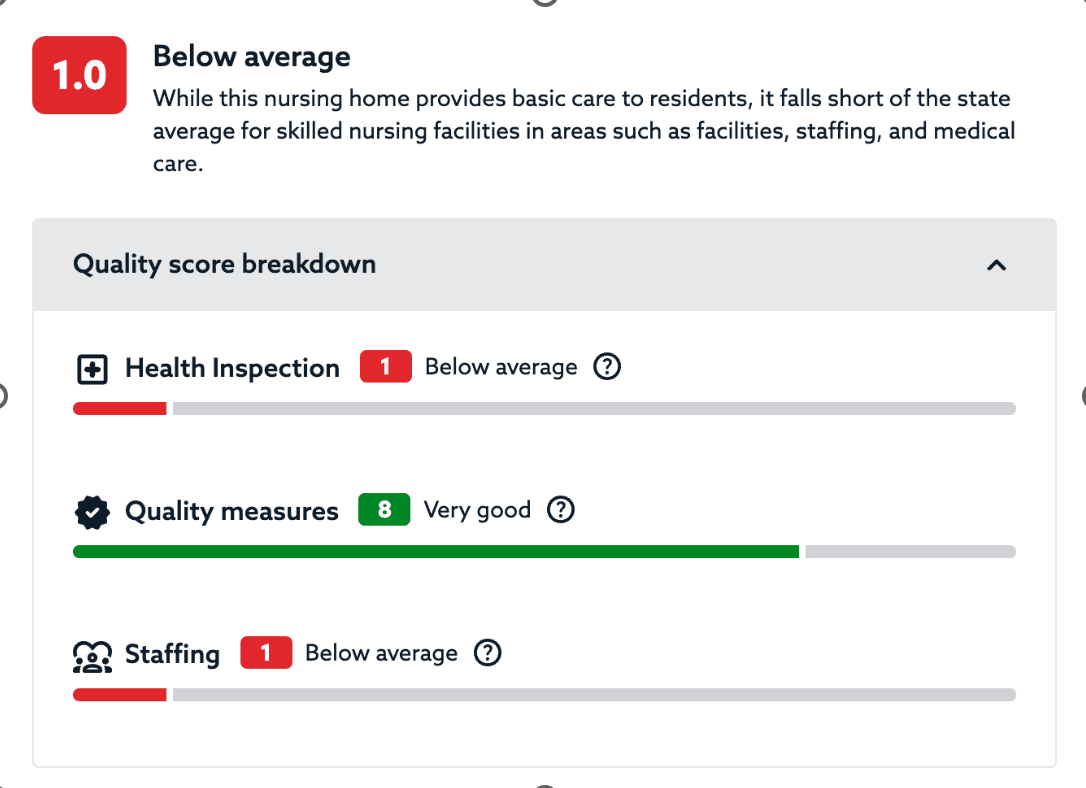
Citations: In CMS reporting, a citation formally documents a deficiency or violation found during a nursing home inspection. Surveyors issue citations when a nursing home fails to meet specific regulatory standards. Citations range in severity, from less serious issues that pose minimal risk to residents to critical violations that may put residents’ health and safety at risk. Each citation describes the observed deficiency, its potential effect on residents, and the regulation or standard the nursing home didn’t meet. Citations are an important part of the reporting system because they make identified problems visible to families and other stakeholders. Reviewing this information can help you understand where a nursing home has fallen short, how serious the concern may be, and what steps the nursing home has taken to address the issue.
A gap between short-stay and long-stay quality scores: A significant gap between short-stay and long-stay scores may suggest that a nursing home performs better in one type of care than the other. For example, it may manage ongoing care needs effectively while having difficulty providing the specialized support required for short-term rehabilitation. Understanding the reasons for the difference can help you make a more nuanced evaluation and determine whether the nursing home’s strengths match your loved one’s needs. A large gap may also suggest that the nursing home hasn’t fully committed to supporting every level of care it offers.
Low staffing ratings: Staffing hours per resident that fall significantly below the state average may raise concerns about whether the nursing home has enough staff to meet residents’ different needs. Insufficient staffing can affect response times, health monitoring, personalized attention, meaningful engagement, and access to essential services. Residents may wait longer for assistance or experience gaps in their day-to-day support. Low staffing may also make it harder for the nursing home to meet regulatory standards and maintain a safe, supportive environment. Although staffing is a nationwide challenge in the current climate, a nursing home that falls well below the state average may be experiencing leadership problems or difficulty hiring and retaining qualified staff. If you’re considering a nursing home with a low staffing rating, weigh these factors carefully. Ask how the team provides timely help, monitors health changes, communicates with residents and their care circles, and meets residents’ daily needs.
CMS Nursing Home Compare also lets you compare nursing home ratings across the United States. You can review overall ratings as well as detailed information about health inspections, staffing levels, and quality of care measures. These reports offer an important starting point, but looking at the details behind each score will give you a fuller picture. Use the reports to narrow your options, then ask each nursing home about any scores, staffing levels, or citations that concern you. Focusing on the measures that match your loved one’s needs can help you move forward with greater clarity and confidence.
CareScout Cost of Care tool
As you evaluate quality measures, you can compare nursing home costs, too. Explore care costs with the Cost of Care survey tool.
Written by


Marlena del Hierro
Marlena del Hierro is a strategic senior care industry leader with over a decade of experience. As Director of Operational Growth at CareScout, she drives growth and forges strategic partnerships, leveraging her MA in Gerontology from San Francisco State University. Pr...