Dementia communication: your go-to guide for connecting



• Patience, simple language, eye contact, and extra response time can make communication less frustrating for you and your loved one.
• Hands-on activities, music, photos, and familiar questions can help children and adults connect with someone who has dementia.
• When speech becomes difficult, touch, visual cues, simple questions, and shared sensory activities may help maintain connection.
Communication helps us connect, whether we’re talking with a new friend or someone we’ve known our whole life. If you have a loved one with Alzheimer’s disease or another form of dementia, you know that communication can become more difficult as the condition progresses. For family and friends, these changes can be some of the hardest to accept and understand.
Changes in conversation are often among the first signs that something isn’t quite right. You may notice forgetfulness, repetition, or more difficulty finding words. As dementia progresses, communication can become harder, both practically and emotionally, for both of you. For family caregivers, communicating effectively is also crucial to managing care responsibilities.
Why is communication difficult for people with dementia?
Dementia is caused by abnormal changes in the brain, which hinder communication between brain cells.1 As a result, the person’s ability to process thoughts, emotions, body language, and even behavior can be affected. Other parts of how they experience the world may also change, frequently leading to confusion and distress.
Alzheimer’s disease is the most common form of dementia, but there are several types, each with its own characteristics. They share key symptoms, including memory problems or memory loss, along with a decline in problem-solving and language skills. Although the loss of working and long-term memory is usually one of the early signs of dementia, communication difficulties can be another signal.
In the early stages, changes may be minimal. Over time, the person with dementia may find it difficult to follow directions. They may not be able to reach a familiar place or remember how to play a favorite card game. Using the microwave may suddenly feel daunting. Even putting toothpaste on a toothbrush can become challenging. As dementia reduces their ability to remember and understand basic information about everyday activities, it’s understandable that family caregivers may become frustrated when they need to repeat information or instructions.
How relationships may change when a family member has dementia
It’s natural for these changes to affect your relationship. You may find yourself becoming a family caregiver for a parent or partner, and that shift can feel overwhelming. The person experiencing memory problems may feel embarrassed about needing care.
The family caregiver role may also change a long-standing dynamic between two people, such as spouses or a parent and child. In every case, dementia can reorder existing dynamics and relationships as a natural result of the disease. It’s completely normal to feel a sense of loss, resentment, or a mix of emotions.
These relationship changes often shift over time as dementia progresses, and your loved one’s experience of the world changes. Your family and care circle may need to readjust regularly and look for new ways to connect.
Common communication changes caused by dementia
You may be wondering what to expect when communicating with someone who has dementia. These conversations can be difficult for the person living with dementia and for their friends, family members, and other loved ones. According to research from the National Institutes of Health, people with dementia may experience several common changes in language. 2
• Trouble remembering words
• Using the wrong word or substituting one word for another
• Describing a word instead of saying the word itself, such as “the white drink” for milk
• Beginning a comment and losing their train of thought, or experiencing other memory problems
• Repeating questions, comments, or stories
• Using more hand gestures
• Becoming frustrated by difficulty speaking
• Speaking less or withdrawing from conversations entirely
How to talk to someone with dementia: 14 dos and don’ts
What can you do to make communication easier? First, try to be patient. Remember that Alzheimer’s disease or another form of dementia is causing these changes, not necessarily the person. Effective communication approaches will vary based on the individual and their stage of dementia. Finding what works may take some trial and error, so be ready to adapt.
These 14 conversation tips can help make communication more enjoyable and less frustrating for both of you.
• Do be patient. This can’t be stressed enough. Whether the challenges involve communication, attitude, behavior, or eating, family caregivers may sometimes find it difficult to stay patient and engaged. That’s normal. When safety allows, step out of the room, take a walk, make time to eat, or do something else that helps you feel calmer. You’ll be better able to support your loved one when you’re in the right frame of mind.
• Do make eye contact and use nonverbal cues or body language to encourage engagement. Face your loved one during the conversation, and stay relaxed while waiting for a response.
• Do speak slowly and simply. Speak clearly, and use familiar words and short sentences. Avoid complex sentence structures.
• Do allow time for a response. People with dementia may take longer to process information, so expect a pause and listen closely.
• Do offer suggestions about what your loved one may be trying to say if they’re clearly struggling to find the right words.
• Do use nonverbal communication , such as a gentle touch, steady eye contact, or leaning toward your loved one while they’re speaking.
• Do provide reassurance with a gentle pat on the shoulder or back. You can also help guide your loved one by gently holding the back of their elbow and pointing.
• Do support their sense of choice. As dementia progresses, limit questions to those that require a yes or no answer. Encourage involvement by offering simple choices.
• Do keep it positive. Avoid criticism and corrections that may increase frustration.
• Do adapt when a question or prompt clearly isn’t being understood. Try asking in a different way, but remember that what you’re asking may be beyond your loved one’s current abilities.
• Do use visual cues if your loved one is having trouble following instructions. Printed or drawn pictures and symbols that represent objects may help someone whose communication skills are declining. This could be as simple as laying out an outfit instead of saying, “Go get dressed.” This resource offers additional support for using visual communication techniques.
• Don’t argue with or challenge your loved one’s statements or feelings. Acknowledge that this is their reality in the moment, and respond with empathy. It’s OK to affirm what they’re saying, respond, or ask gentle questions. You may learn a lot.
• Don’t patronize. Although you may simplify your speech, avoid patronizing tones, “baby talk,” or other communication that treats your loved one like a child.
• Don’t overstimulate. If you want to have a conversation, limit background noise and other distractions. Turn off the TV or radio, and set aside devices such as laptops or cellphones. This is helpful advice for any conversation, but it’s especially important for someone with cognitive changes who may have difficulty tuning out distractions.
Tips for helping children communicate with someone who has dementia
These suggestions can help adults, but children and young adults may need extra preparation before spending time with someone who has dementia. Children may feel confused or upset when a relative or neighbor begins showing signs of dementia, especially if they’ve known the person for a long time. Teenagers and young adults may avoid visits because the changes make them uncomfortable. They may prefer to remember the person as they were, or they may simply not know what to say.
9 activities for people with dementia and young children
The National Institute on Aging (NIA) suggests that sensory stimulation and hands-on activities may offer children a more natural way to connect with a loved one or acquaintance who has dementia. 3
Before the visit, prepare children and young adults for the changes they may notice, and plan a few activities they can lead. If you’re the parent or guardian of a young child, try to keep your body language relaxed and calm because young children may be especially sensitive to stress.
Here are a few sensory activities that children and adults with dementia can enjoy together. You may need some trial and error because the right activities will depend on your loved one’s personality and stage of dementia.
• Work on a puzzle together. Puzzles can be collaborative and fun for people with dementia. They can strengthen cognition and provide a sense of accomplishment for both older adults and young children. Some puzzles are designed specifically for people with dementia.
• Try an arts-and-crafts project, such as a paint-by-number kit, magazine collage, painted rocks, a still life, slime, or play dough. These hands-on activities can be fun and rewarding for children and older adults while allowing for meaningful nonverbal communication.
• Look through old photo albums, or invite teenagers to share their Instagram feeds and explain what they’re showing. Communication doesn’t always need to move in one direction. Children should also feel encouraged and prepared to share parts of their lives.
• Play music. See how many songs the older adult and child both recognize, or ask each person to share favorite songs. People with dementia may remember the words to familiar songs well into the progression of the disease. Play traditional songs or carols that both people know, and sing along. Toe-tapping and clapping are encouraged.
• Play balloon tennis. Blow up a balloon and volley it from person to person. It’s a low-pressure activity without a focus on winning or losing.
• Blow bubbles. This can be an enjoyable outdoor activity to share with young children.
• Play with dolls. There is some evidence that doll therapy has positive benefits for people with dementia. 4 making doll play a natural way for younger children to connect with a family member who has dementia. This can also be true for men with dementia.
• Go online. Children may want to share favorite simple game apps, such as Slither, Snowball, Pizza Maker, or one of the many piano apps.
• Share a good book. As dementia progresses, reading may become difficult, but that doesn’t mean your loved one no longer enjoys a good story. Younger children can practice their reading skills, while older children or young adults can read aloud from a favorite book. The activity itself matters less than the connection formed through reading and listening. This can also be true for men with dementia.
10 questions to ask someone with dementia
Asking questions can be an enjoyable way for loved ones of any age to connect. Start by sharing some of your own favorite memories or favorite things. Then try these conversation starters to inspire memories and keep the conversation moving:
• Did you ever have a pet? What kind?
• Do you like to shop? What’s your favorite store?
• What was your favorite food growing up? Do you cook or bake? What kinds of things?
• Do you have a favorite family vacation?
• What’s your favorite TV show, movie, or kind of music? Did you ever play an instrument?
• What’s your favorite time of year? Why?
• Who was your best friend growing up? What kinds of things did you do together?
• What was your first job? What did you like about it?
• What was your mother or father like?
• Do you have any hobbies?
How to connect when someone with dementia has difficulty speaking
In the later stages of dementia, language skills may become increasingly limited. Some people become nonverbal and withdraw from social interaction. Family caregivers may also begin interacting less often. For some people with late-stage dementia, a memory care community can benefit both the person receiving care and their loved ones. Even when professional caregivers manage day-to-day care, regular visits can help you maintain your connection.
Nonverbal communication, such as gentle hand massaging or hugging may help someone with dementia maintain positive interactions with others.
Animals can also provide a meaningful connection for an older adult experiencing cognitive and communication challenges. If you don’t have a suitable pet, you can search for local organizations that are available to provide animals for therapeutic visits. You can also consider a robotic pet as a source of comfort for your loved one.
Ask simple yes or no questions that your loved one can answer with a nod or shake of the head.
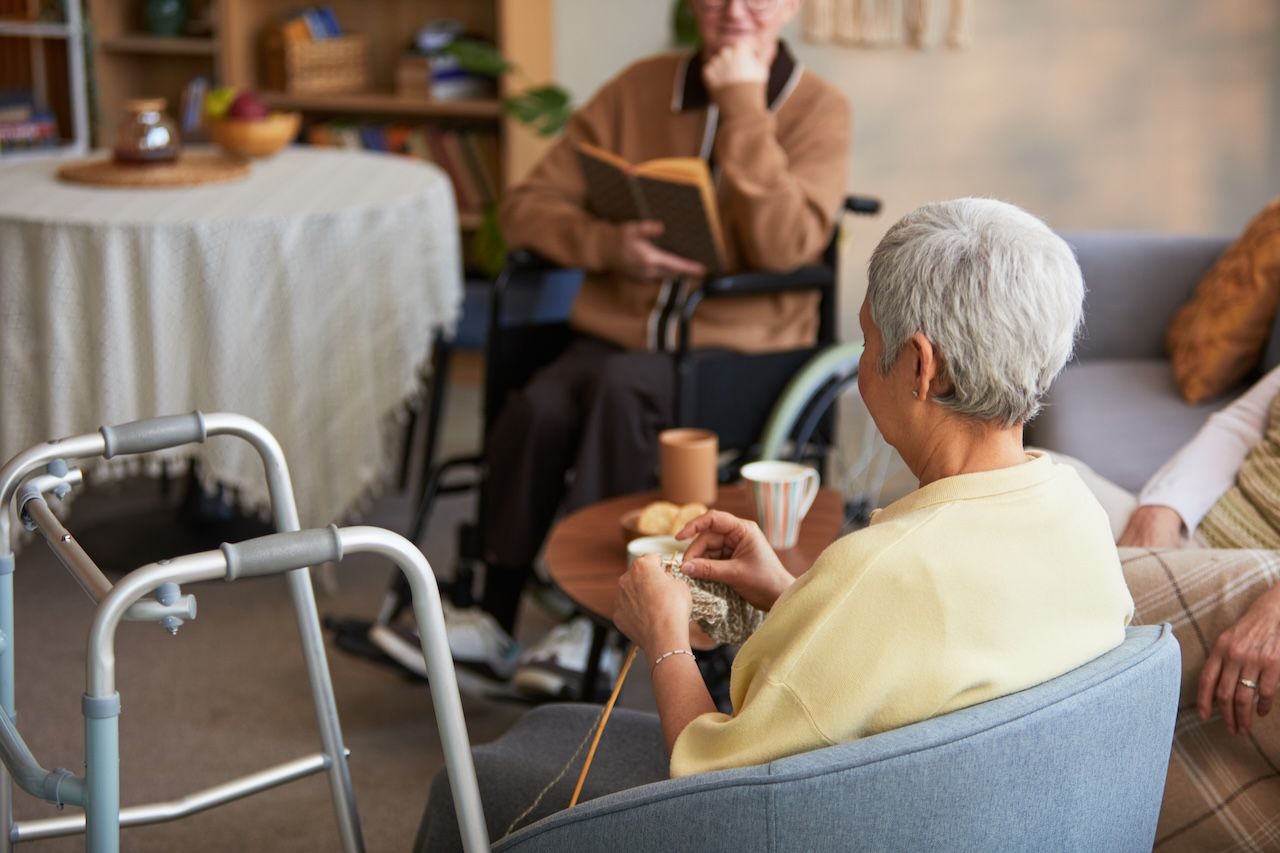
Try tactile stimulation. Consider sensory activities such as knitting, sanding wood, folding laundry, or organizing silverware, pens, or pencils.
Finally, never underestimate the joy your smile may bring to your loved one.
Access our full guide to dementia care
Read our Detailed Guide to Dementia Care for more tips, information, and resources.
Expert reviewed by


Angelica P. Herrera-Venson, DrPH, MPH
Angelica Herrera-Venson reviews content related to healthy aging and caregiving for Seniorly. With deep experience in public health policy and analysis, Dr. Herrera-Venson has focused much of her career in gerontology and public health. She has over 20 years of experie...
Written by

Sue Sveum
Sue Sveum is a contributing writer, specializing in Alzheimer's and dementia topics. With a background in healthcare, Sue has worked with the American Cancer Society and Hospice Care. Her transition to writing about seniors and memory loss was inspired by her perso...